
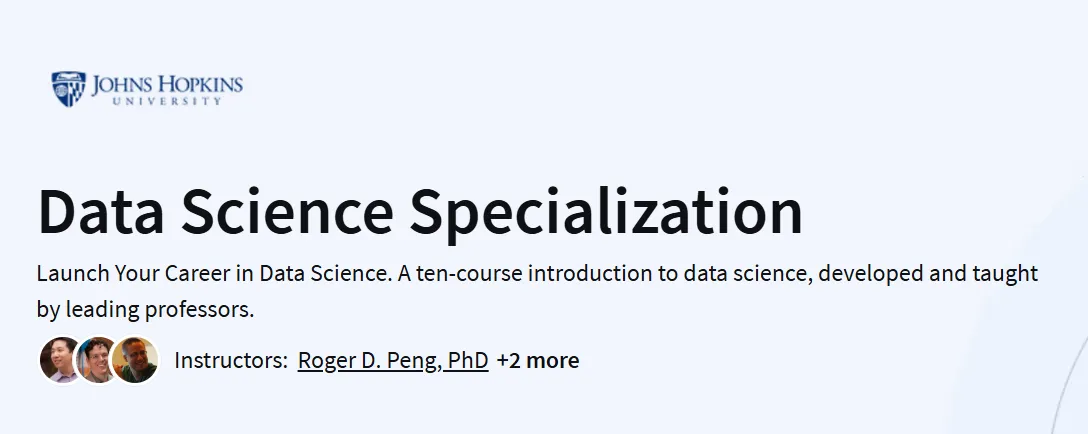
The Data Scientist’s Toolbox
2-3 weeks
- Learn about the data science field, including tools like R, RStudio, Git, and GitHub.
- Understand how to structure a data science project and practice version control.
- Set up your environment for data analysis.
R Programming
3-4 weeks
- Dive deep into R programming basics and data structures.
- Learn looping, functions, and debugging.
- Practice writing efficient R code for data analysis.
Getting and Cleaning Data
2-3 weeks
- Learn how to collect, clean, and preprocess data for analysis.
- Work with APIs, web scraping, and data reshaping tools.
- Handle missing values and standardize data formats.
Exploratory Data Analysis
2-3 weeks
- Visualize and summarize data with base R and ggplot2.
- Understand distributions, trends, and relationships in datasets.
- Identify outliers and patterns through graphical analysis.
Reproducible Research
1-2 weeks
- Learn how to create fully reproducible analytical reports using R Markdown.
- Understand documentation practices and reproducibility in research.
- Integrate code, visualizations, and narratives into a single document.
Statistical Inference
2-3 weeks
- Learn about probability theory, sampling, and hypothesis testing.
- Understand confidence intervals and p-values.
- Use simulations to validate statistical models.
Practical Machine Learning
2-3 weeks
- Understand machine learning algorithms and model evaluation.
- Practice classification, clustering, and prediction tasks.
- Learn how to split data into training and testing sets and tune model parameters.
Developing Data Products
2-3 weeks
- Build interactive web apps using Shiny.
- Create dynamic reports and visual dashboards.
- Learn product design concepts and user interaction fundamentals.
Data Science Capstone
4-6 weeks
- Apply all your learned skills to a real-world data science project.
- Solve a business or research problem using publicly available data.
- Present your findings in a reproducible, professional format.
Job Outlook
- Data science roles are projected to grow by 36% through 2031, far above the average (U.S. Bureau of Labor Statistics).
- Entry-level data scientists earn between $85,000 – $110,000, with senior roles reaching $150,000+.
- Demand spans industries like tech, healthcare, finance, e-commerce, and government.
- Employers seek proficiency in R, statistics, machine learning, and data visualization.
- The specialization provides a strong foundation for roles such as Data Analyst, Data Scientist, and Research Analyst.
Explore More Learning Paths
Advance your data science skills with these expertly curated courses designed to provide foundational knowledge and hands-on experience in analyzing and interpreting complex data.
Related Courses
Related Reading
Gain deeper insight into how data-driven decision-making transforms industries:
Last verified: March 12, 2026
Who Should Take Data Science Specialization – By Johns Hopkins University Course?
This course is best suited for learners with no prior experience in data science. It is designed for career changers, fresh graduates, and self-taught learners looking for a structured introduction. The course is offered by Johns Hopkins University on Coursera, combining institutional credibility with the flexibility of online learning. Upon completion, you will receive a certificate of completion that you can add to your LinkedIn profile and resume, signaling your verified skills to potential employers.
If you are exploring adjacent fields, you might also consider courses in Arts and Humanities Courses, Business & Management Courses, Computer Science Courses, which complement the skills covered in this course.
FAQs
What do learners think of this specialization's teaching and effectiveness?
Many appreciate its comprehensiveness and real-world orientation as an "R-focused" complete data science pipeline. Some learners find specific parts like R Programming or Statistical Inference to be too basic or simplistic—highlighting that it's more foundational than deep.
Does the specialization include hands-on work and a capstone project?
Yes—each course includes practical assignments, culminating in a Capstone Project, where you create a real-world data product using R. By the end, you'll have a demonstrable portfolio of coding, analysis, visualization, and product-building work.
What is the structure of the specialization and how long does it take?
Composed of 10 sequential courses, covering topics like R programming, data cleaning, exploratory data analysis, statistical inference, regression, practical ML, reproducibility, and a capstone. Estimated completion time is 7 months at 10 hours per week, though quicker or slower pacing is supported.
What essential skills and tools does the program teach?
Master R for data manipulation, exploratory visualization, statistical inference, regression, machine learning, and version control with GitHub. Learn the full data science workflow—from data cleaning to reproducible research and building interactive data products.
Is this specialization really beginner-friendly or do I need prior experience?
Yes—it's labeled beginner level, and only basic familiarity with Python and elementary regression analysis is recommended, not mandatory. Designed for self-paced learning, ideal for newcomers comfortable with foundational analytics concepts.
What are the prerequisites for Data Science Specialization – By Johns Hopkins University Course?
No prior experience is required. Data Science Specialization – By Johns Hopkins University Course is designed for complete beginners who want to build a solid foundation in Data Science. It starts from the fundamentals and gradually introduces more advanced concepts, making it accessible for career changers, students, and self-taught learners.
Does Data Science Specialization – By Johns Hopkins University Course offer a certificate upon completion?
Yes, upon successful completion you receive a certificate of completion from Johns Hopkins University. This credential can be added to your LinkedIn profile and resume, demonstrating verified skills to employers. In competitive job markets, having a recognized certificate in Data Science can help differentiate your application and signal your commitment to professional development.
How long does it take to complete Data Science Specialization – By Johns Hopkins University Course?
The course is designed to be completed in a few weeks of part-time study. It is offered as a lifetime course on Coursera, which means you can learn at your own pace and fit it around your schedule. The content is delivered in English and includes a mix of instructional material, practical exercises, and assessments to reinforce your understanding. Most learners find that dedicating a few hours per week allows them to complete the course comfortably.
What are the main strengths and limitations of Data Science Specialization – By Johns Hopkins University Course?
Data Science Specialization – By Johns Hopkins University Course is rated 9.5/10 on our platform. Key strengths include: covers entire data science lifecycle from basics to deployment.; taught by professors from a top-ranked university.; strong focus on reproducibility and hands-on learning.. Some limitations to consider: heavy focus on r; limited python exposure.; requires self-discipline due to self-paced format.. Overall, it provides a strong learning experience for anyone looking to build skills in Data Science.
How will Data Science Specialization – By Johns Hopkins University Course help my career?
Completing Data Science Specialization – By Johns Hopkins University Course equips you with practical Data Science skills that employers actively seek. The course is developed by Johns Hopkins University, whose name carries weight in the industry. The skills covered are applicable to roles across multiple industries, from technology companies to consulting firms and startups. Whether you are looking to transition into a new role, earn a promotion in your current position, or simply broaden your professional skillset, the knowledge gained from this course provides a tangible competitive advantage in the job market.
Where can I take Data Science Specialization – By Johns Hopkins University Course and how do I access it?
Data Science Specialization – By Johns Hopkins University Course is available on Coursera, one of the leading online learning platforms. You can access the course material from any device with an internet connection — desktop, tablet, or mobile. Once enrolled, you have lifetime access to the course material, so you can revisit lessons and resources whenever you need a refresher. All you need is to create an account on Coursera and enroll in the course to get started.
How does Data Science Specialization – By Johns Hopkins University Course compare to other Data Science courses?
Data Science Specialization – By Johns Hopkins University Course is rated 9.5/10 on our platform, placing it among the top-rated data science courses. Its standout strengths — covers entire data science lifecycle from basics to deployment. — set it apart from alternatives. What differentiates each course is its teaching approach, depth of coverage, and the credentials of the instructor or institution behind it. We recommend comparing the syllabus, student reviews, and certificate value before deciding.