What you will learn in Data Science Specialization Course
- Data Manipulation and Analysis with R: Utilize R programming for data cleaning, analysis, and visualization.
- Statistical Inference and Regression Models: Apply statistical methods to draw meaningful insights and build predictive models.
- Machine Learning Techniques: Implement algorithms for predictive analytics and pattern recognition.
- Reproducible Research Practices: Ensure transparency and reliability in data analysis through reproducible workflows.
- Data Product Development: Develop interactive data products and visualizations to communicate findings effectively.
- Version Control with GitHub: Manage and document projects using Git and GitHub.
Program Overview
The Data Scientist’s Toolbox
⏱️2-3 weeks
- Learn about the data science field, including tools like R, RStudio, Git, and GitHub.
- Understand how to structure a data science project and practice version control.
- Set up your environment for data analysis.
R Programming
⏱️3-4 weeks
- Dive deep into R programming basics and data structures.
- Learn looping, functions, and debugging.
- Practice writing efficient R code for data analysis.
Getting and Cleaning Data
⏱️2-3 weeks
- Learn how to collect, clean, and preprocess data for analysis.
- Work with APIs, web scraping, and data reshaping tools.
- Handle missing values and standardize data formats.
Exploratory Data Analysis
⏱️2-3 weeks
- Visualize and summarize data with base R and ggplot2.
- Understand distributions, trends, and relationships in datasets.
- Identify outliers and patterns through graphical analysis.
Reproducible Research
⏱️1-2 weeks
- Learn how to create fully reproducible analytical reports using R Markdown.
- Understand documentation practices and reproducibility in research.
- Integrate code, visualizations, and narratives into a single document.
Statistical Inference
⏱️2-3 weeks
- Learn about probability theory, sampling, and hypothesis testing.
- Understand confidence intervals and p-values.
- Use simulations to validate statistical models.
Practical Machine Learning
⏱️2-3 weeks
- Understand machine learning algorithms and model evaluation.
- Practice classification, clustering, and prediction tasks.
- Learn how to split data into training and testing sets and tune model parameters.
Developing Data Products
⏱️2-3 weeks
- Build interactive web apps using Shiny.
- Create dynamic reports and visual dashboards.
- Learn product design concepts and user interaction fundamentals.
Data Science Capstone
⏱️4-6 weeks
- Apply all your learned skills to a real-world data science project.
- Solve a business or research problem using publicly available data.
- Present your findings in a reproducible, professional format.
Get certificate
Job Outlook
- Data science roles are projected to grow by 36% through 2031, far above the average (U.S. Bureau of Labor Statistics).
- Entry-level data scientists earn between $85,000 – $110,000, with senior roles reaching $150,000+.
- Demand spans industries like tech, healthcare, finance, e-commerce, and government.
- Employers seek proficiency in R, statistics, machine learning, and data visualization.
- The specialization provides a strong foundation for roles such as Data Analyst, Data Scientist, and Research Analyst.
Explore More Learning Paths
Advance your data science skills with these expertly curated courses designed to provide foundational knowledge and hands-on experience in analyzing and interpreting complex data.
Related Courses
What Is Data Science Course – Understand the fundamentals of data science, its applications, and the key skills required to succeed in the field.
Foundations of Data Science Course – Build a solid foundation in data science concepts, including statistics, data visualization, and exploratory analysis.
Tools for Data Science Course – Gain proficiency in essential data science tools and programming languages to efficiently analyze and process data.
Related Reading
Gain deeper insight into how data-driven decision-making transforms industries:
What Is Data Management? – Learn how effective data management underpins data science workflows and ensures accurate, reliable insights.
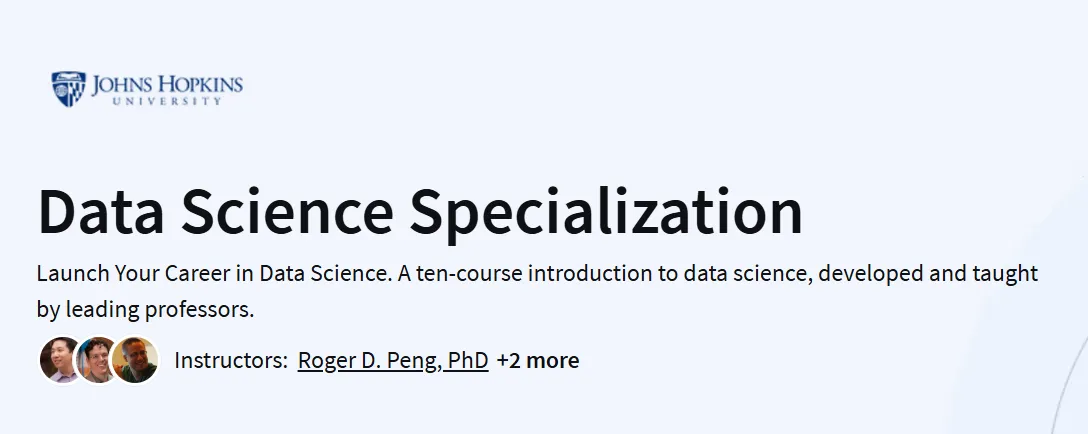
Specification: Data Science Specialization – By Johns Hopkins University Course
|
FAQs
- Composed of 10 sequential courses, covering topics like R programming, data cleaning, exploratory data analysis, statistical inference, regression, practical ML, reproducibility, and a capstone.
- Estimated completion time is 7 months at 10 hours per week, though quicker or slower pacing is supported.