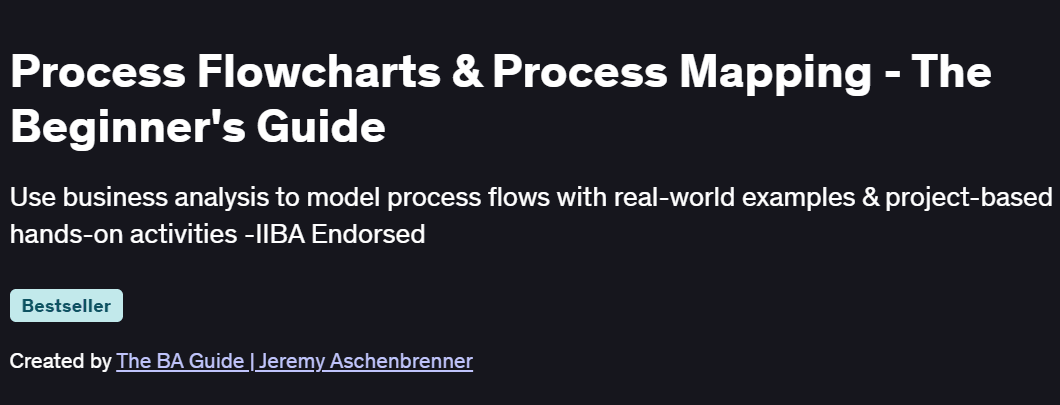
What you will learn in Process Flowcharts & Process Mapping – The Beginner’s Guide Course
- Learners will understand the importance of process mapping in visualizing workflows and identifying areas for improvement.
- The course covers various types of process flowcharts, including basic flowcharts, swimlane diagrams, and value stream maps.
- Students will explore how to use flowcharting techniques to analyze processes, eliminate inefficiencies, and optimize workflows.
-
The course teaches the symbols, standards, and best practices for creating clear, effective process flowcharts that communicate ideas efficiently.
-
Learners will gain hands-on experience in mapping processes and creating flowcharts for real-world applications in business.
Program Overview
Introduction to Process Mapping
⏳ 2-4 weeks
-
Understand the basics of process mapping and its significance in business process management.
-
Learn about different types of process maps and flowcharts, and when to use each type.
-
Explore how process mapping helps in visualizing processes for better decision-making and optimization.
Process Flowcharting Basics
⏳ 4-6 weeks
-
Study the key symbols used in flowcharting, such as ovals, rectangles, diamonds, and arrows, and their meanings.
-
Learn the standard flowcharting rules and conventions to ensure clarity and consistency in your diagrams.
-
Understand the structure of a flowchart, including start and end points, decision points, and process steps.
Creating Basic Process Flowcharts
⏳ 4-6 weeks
-
Learn how to create simple flowcharts for everyday business processes, such as order fulfillment, customer support, and product development.
-
Explore the process of defining process boundaries, identifying stakeholders, and mapping key actions within the workflow.
-
Understand how to use flowcharts to visualize and simplify complex processes.
Advanced Flowcharting Techniques
⏳ 6-8 weeks
- Learn how to create more advanced process flowcharts, such as swimlane diagrams and value stream maps, to represent more complex workflows.
- Explore how to map cross-functional processes and interactions between different teams using swimlanes.
- Study how value stream mapping helps identify waste and inefficiencies in processes and leads to process improvements.
Process Improvement & Optimization
⏳ 4-6 weeks
- Understand how to use process maps and flowcharts to identify bottlenecks, inefficiencies, and areas for improvement.
- Learn strategies for redesigning processes to eliminate waste, reduce cycle times, and increase efficiency.
- Study how to implement continuous improvement processes like Kaizen in your workflows.
Final Project: Create a Process Map
⏳ 6-8 weeks
- Apply the concepts learned throughout the course to map a real-world process from start to finish.
- Create a comprehensive process flowchart, identifying inefficiencies and proposing improvements.
- Present your process map for feedback and improvement suggestions.
Get certificate
Job Outlook
-
Process mapping and flowcharting are valuable skills in industries like manufacturing, healthcare, IT, and logistics.
-
Professionals skilled in process mapping and process improvement can expect roles such as process analyst, business analyst, and operations manager, with entry-level salaries ranging from $50K to $75K.
-
Process improvement professionals with expertise in flowcharting can earn $90K to $120K+ in senior positions, depending on experience.