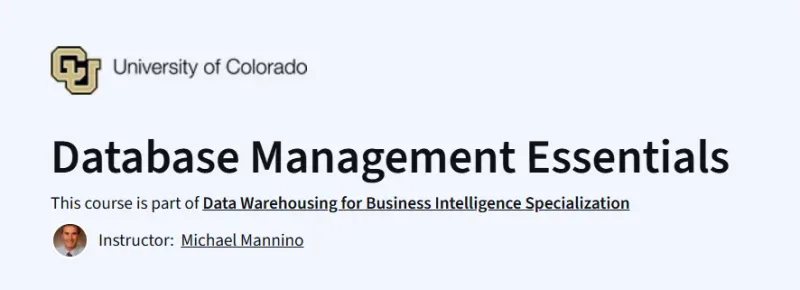
What will you learn in Database Management Essentials Course
- This course provides a comprehensive introduction to database management systems (DBMS) and relational database concepts.
- Learners will understand how databases store, organize, and retrieve structured data efficiently.
- The program emphasizes SQL querying, data modeling, and relational schema design.
- Students will explore normalization techniques and entity-relationship (ER) diagrams.
- Practical exercises demonstrate how to create, manage, and query databases.
- By completing the course, participants gain foundational database skills aligned with data analysis, backend development, and IT roles.
Program Overview
Introduction to Database Systems
⏳ 2–3 Weeks
- Understand the role of databases in organizations.
- Learn differences between relational and non-relational systems.
- Explore DBMS architecture fundamentals.
- Study data storage concepts.
Relational Modeling and Design
⏳ 2–3 Weeks
- Create entity-relationship (ER) diagrams.
- Understand primary and foreign keys.
- Apply normalization principles.
- Design structured relational schemas.
SQL Querying and Data Manipulation
⏳ 2–3 Weeks
- Write SELECT queries with filtering and sorting.
- Use joins to combine multiple tables.
- Apply aggregate functions and grouping.
- Perform INSERT, UPDATE, and DELETE operations.
Database Integrity and Security Basics
⏳ Final Module
- Understand constraints and data validation.
- Learn transaction fundamentals.
- Explore basic database security practices.
- Apply performance optimization concepts.
Get certificate
Job Outlook
- Database management skills are essential in IT, software development, finance, healthcare, retail, and technology sectors.
- Professionals trained in database systems are sought for roles such as Database Administrator, Data Analyst, Backend Developer, and Business Intelligence Analyst.
- Entry-level database professionals typically earn between $70K–$95K per year, while experienced database engineers and architects can earn $110K–$160K+ depending on specialization and region.
- SQL remains one of the most in-demand technical skills globally.
- This course provides strong preparation for further database certifications and advanced data engineering pathways.