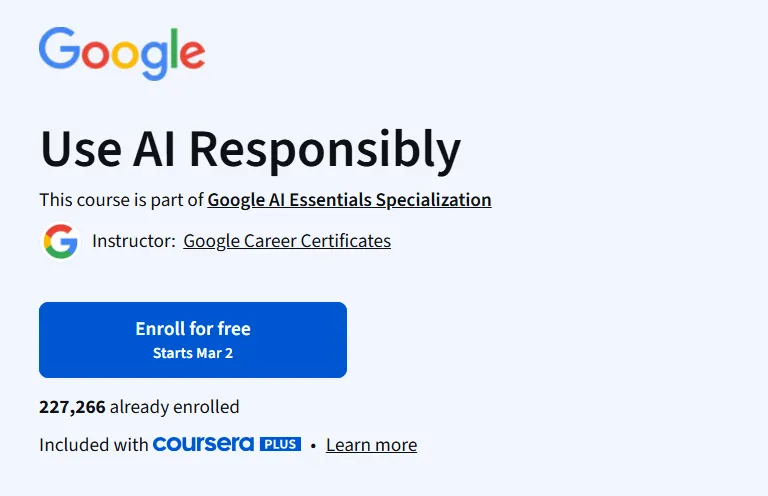
What will you learn in Use AI Responsibly course
- This course provides a foundational understanding of responsible AI practices and ethical AI usage in professional environments. It focuses on helping learners use artificial intelligence tools safely, ethically, and effectively.
- Learners will explore core AI concepts, including how generative AI systems work, their limitations, and potential risks. The course emphasizes identifying bias, misinformation, and inaccuracies in AI-generated outputs.
- You will gain practical knowledge about data privacy, security considerations, and compliance standards when using AI tools in the workplace.
- The course highlights Google’s AI principles and global best practices to ensure fairness, transparency, and accountability in AI applications.
- Real-world examples and workplace scenarios help learners apply responsible AI frameworks to everyday business tasks.
Program Overview
Introduction to Responsible AI
⏳ 1–2 weeks
- In this section, you will explore the fundamentals of AI ethics and governance.
- Understand what responsible AI means in business contexts.
- Learn about the benefits and risks of generative AI systems.
- Explore real-world examples of AI misuse and ethical challenges.
- Recognize the importance of accountability in AI-driven decisions.
Bias, Fairness & Transparency
⏳ 1–2 weeks
- This section focuses on identifying and mitigating bias in AI systems.
- Learn how AI models can inherit biases from training data.
- Understand fairness principles in AI deployment.
- Explore transparency and explainability concepts.
- Apply strategies to reduce biased outputs in workplace applications.
Privacy, Security & Data Protection
⏳ 1–2 weeks
- Here, you will examine privacy concerns and safe AI usage practices.
- Understand data handling best practices when using AI tools.
- Learn about compliance, confidentiality, and regulatory considerations.
- Identify potential security risks when integrating AI into workflows.
- Develop safe data-sharing habits in AI-assisted environments.
Human Oversight & Ethical Decision-Making
⏳ 1 week
- This section emphasizes the importance of human involvement in AI systems.
- Learn how to verify AI-generated outputs before implementation.
- Understand limitations and common hallucination risks in generative AI.
- Develop ethical decision-making frameworks for AI use.
- Apply responsible AI checklists to real-world scenarios.
Practical Responsible AI Application
⏳ 1 week
- In the final section, you will apply responsible AI principles in practical tasks.
- Evaluate AI-generated content for accuracy and fairness.
- Implement risk-mitigation strategies in simulated workplace scenarios.
- Create responsible AI usage guidelines for professional settings.
- Demonstrate safe AI adoption skills aligned with industry standards.
Get certificate
Job Outlook
- Responsible AI knowledge is becoming essential across industries such as technology, healthcare, finance, education, and government.
- Organizations increasingly prioritize ethical AI governance and compliance.
- Professionals with responsible AI expertise are valuable in roles like AI Policy Analyst, Compliance Officer, Risk Manager, Data Analyst, and Product Manager.
- AI regulations and data protection laws are expanding globally, increasing demand for AI governance skills.
- Companies seek employees who understand both AI capabilities and ethical boundaries.
- Responsible AI training enhances credibility in AI-driven roles and leadership positions.
- AI governance knowledge supports career growth in AI, data science, cybersecurity, and digital transformation roles.
- As AI adoption accelerates, ethical and responsible usage becomes a competitive advantage for organizations and professionals.