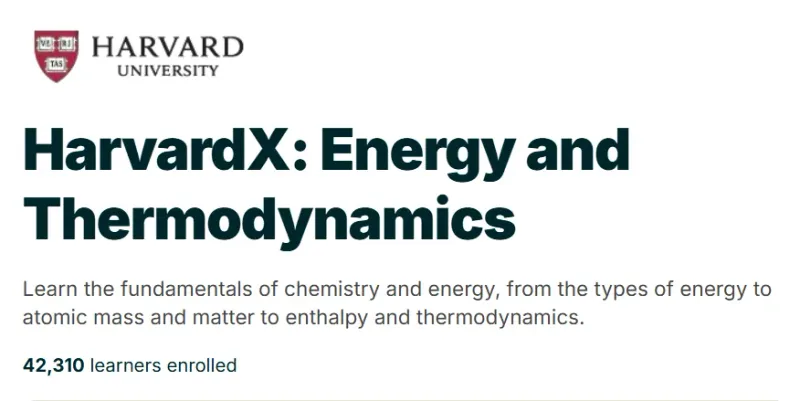
What will you learn in HarvardX: Energy and Thermodynamics course
- This course introduces the core principles of thermodynamics and energy transformation in chemical and physical systems.
- Learners will understand the laws of thermodynamics and how energy is conserved and transferred.
- The program emphasizes entropy, enthalpy, and free energy in chemical reactions.
- Students will explore heat, work, and equilibrium in both laboratory and theoretical contexts.
- Mathematical modeling is integrated to analyze energy changes quantitatively.
- By completing the course, participants gain a rigorous scientific foundation essential for chemistry, physics, and engineering pathways.
Program Overview
Foundations of Energy and the First Law
⏳ 3–4 Weeks
- Understand internal energy and heat transfer.
- Explore work and energy conservation principles.
- Apply the First Law of Thermodynamics.
- Solve energy balance equations.
The Second Law and Entropy
⏳ 3–4 Weeks
- Understand entropy and spontaneity.
- Analyze reversible and irreversible processes.
- Apply the Second Law of Thermodynamics.
- Interpret disorder and probability concepts.
Free Energy and Chemical Equilibrium
⏳ 3–4 Weeks
- Understand Gibbs free energy.
- Relate thermodynamics to chemical reactions.
- Explore equilibrium constants.
- Predict reaction spontaneity.
Applications and Quantitative Modeling
⏳ Final Module
- Model thermodynamic systems mathematically.
- Analyze heat engines and efficiency.
- Apply thermodynamics to real chemical systems.
- Strengthen analytical problem-solving skills.
Get certificate
Job Outlook
- Thermodynamics knowledge is essential for careers in chemical engineering, materials science, energy systems, environmental science, and physical chemistry.
- Professionals with strong thermodynamics foundations are sought for roles such as Chemical Engineer, Energy Analyst, Research Scientist, Materials Engineer, and Process Engineer.
- Entry-level engineering and physical science professionals typically earn between $70K–$100K per year, while experienced specialists and researchers can earn $110K–$180K+ depending on specialization and region.
- Thermodynamics also forms the foundation for advanced research in renewable energy, sustainability, and industrial process optimization.
- This course strongly supports preparation for graduate studies in chemistry, engineering, and applied physics.