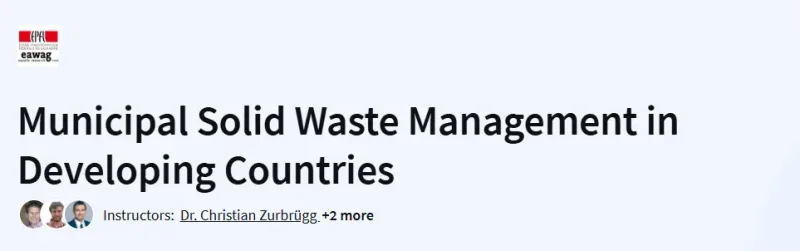
What will you learn in this Municipal Solid Waste Management in Developing Countries Course
-
Understand the challenges and opportunities in managing municipal solid waste in low- and middle-income countries.
-
Explore the technical, environmental, social, financial, and institutional aspects of waste management systems.
-
Learn about sustainable solutions and best practices through real-world case studies.
-
Apply the Integrated Sustainable Waste Management (ISWM) framework to analyze and improve waste management practices.
Program Overview
1. Physical Elements of Solid Waste Management
⏳ 2 hours
Introduction to the current waste management situation in developing countries and the ISWM framework.
2. Governance Aspects
⏳ 2 hours
Examination of policy, regulation, and institutional roles in waste management.
3. Financial Aspects
⏳ 2 hours
Analysis of funding mechanisms, cost recovery, and economic sustainability.
4. Environmental and Health Aspects
⏳ 2 hours
Assessment of environmental impacts and health risks associated with waste management.
5. Social Aspects
⏳ 2 hours
Exploration of community involvement, public awareness, and stakeholder engagement.
6. Waste Collection and Transport
⏳ 2 hours
Strategies for efficient collection and transportation of municipal solid waste.
7. Waste Treatment and Disposal
⏳ 2 hours
Overview of treatment technologies and disposal methods suitable for developing countries.
8. Recycling and Resource Recovery
⏳ 2 hours
Insights into recycling practices and the role of the informal sector.
9. Planning and Implementation
⏳ 2 hours
Guidance on developing and executing effective waste management plans.
10. Case Studies and Practical Applications
⏳ 2 hours
Real-world examples illustrating successful waste management interventions.
Get certificate
Job Outlook
-
Equips learners for roles such as Environmental Consultant, Waste Management Specialist, and Urban Planner.
-
Applicable in sectors like public health, environmental NGOs, municipal services, and international development agencies.
-
Enhances employability by providing practical skills in sustainable waste management practices.
-
Supports career advancement in fields focused on environmental sustainability and urban development.